
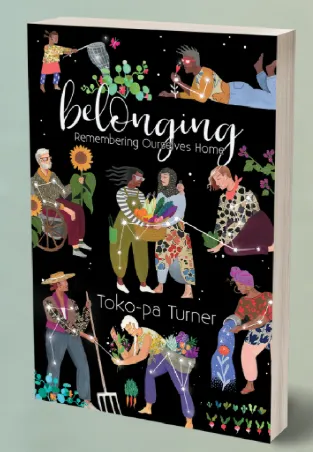
Books We Love: Belonging: Remembering Ourselves Home by Toko-pa Turner
There are some books that do not simply inform you; they meet you. Belonging: Remembering Ourselves Home is one of them. Toko-pa Turner has written a work that feels less like a book and more like an initiation—an invitation to return to the parts of yourself you exiled long ago. For women on a path of inner awakening, this book offers both language and guidance for the deep yearning to come home to who you truly are.
What makes Turner’s work so resonant is that she names an ache many women carry without knowing its origin. This ache is the sense of unbelonging, not just in family systems or culture, but within the self. She explains how belonging is not something granted to us from the outside, but something we cultivate through relationship with our inner world. This shift alone is revolutionary. It breaks the inherited belief that belonging must be earned, performed, or negotiated.
Turner’s writing blends mythology, dreamwork, feminine psychology, and soulful storytelling. Her message is clear: the parts of you that feel unacceptable, inconvenient, too emotional, or too tender are often the very parts that hold the key to your wholeness. Rather than urging us to “fix” ourselves, she invites us to reclaim the exiled pieces—the shadow selves, the inner child, the instincts, the griefs—as essential members of the inner family.
One of the most powerful through-lines in the book is her teaching that belonging is a practice of remembering. We remember our intuition, our creativity, our longings, and our deep relational nature. Turner reminds us that belonging is not a destination, but a rhythm—a way of being in relationship with self, others, and the unseen world.
As you move through the chapters, you can feel a softening. Her writing is gentle, but unflinching. She names how patriarchy, productivity culture, and intergenerational trauma sever us from belonging, yet she does so with compassion rather than blame. The invitation is not to identify villains, but to restore inner connection.
What sets this book apart is the emotional permission it offers. It validates the feeling of being different, sensitive, or out of place. It also affirms that longing itself is sacred. Longing reveals where we have abandoned ourselves, and where we are being called home.
For those on a path of embodiment, Turner’s emphasis on dreams, symbols, and myth may be especially powerful. She presents imagination not as fantasy, but as a bridge between the conscious and unconscious—a place where belonging is repaired from the inside out.
Belonging: Remembering Ourselves Home is a book to savor slowly. It is a companion for women doing inner reclamation work, for those healing shame, and for anyone longing to feel more at home in their skin and in their life. It reminds us that we do not belong because we fit in. We belong because we return to ourselves.
If you are on a journey of remembering who you are beneath the conditioning, this book is a beautiful and transformative guide.


